
The Ultimate 2026 Malaysia Payroll Guide: SOCSO, EIS, PCB Tables & OT Calculations
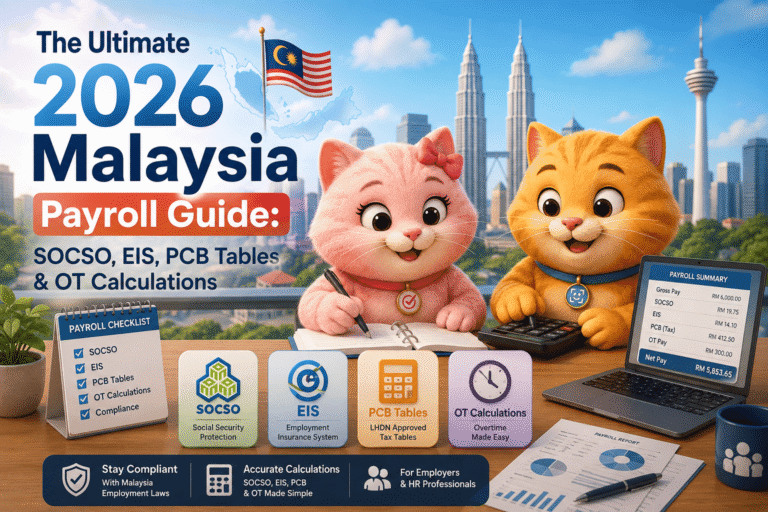
Managing payroll in Malaysia requires more than simply paying employees on time. HR teams must ensure that every payroll cycle complies with the latest statutory regulations, including SOCSO (PERKESO), Employment Insurance System (EIS), Potongan Cukai Berjadual (PCB), and overtime (OT) calculations under Malaysian employment laws.
As statutory requirements continue to evolve, manual payroll processing increases the risk of errors, compliance issues, and costly penalties. Whether you manage a growing SME or a large enterprise, keeping up with the latest contribution tables and payroll regulations is essential for maintaining accurate payroll records.
This 2026 Malaysia Payroll Guide explains the latest SOCSO contribution table, EIS contributions, PCB deductions, overtime calculations, and how modern payroll software can help automate payroll while improving efficiency and compliance.
Understanding Payroll Compliance in Malaysia
Payroll compliance involves ensuring employees receive the correct salary while statutory deductions are calculated accurately and submitted on time.
A compliant payroll process typically includes:
- Salary Processing
- EPF Contributions
- SOCSO (PERKESO) Contributions
- EIS Contributions
- PCB (Monthly Tax Deduction)
- Overtime Calculation
- Leave Adjustments
- Claims Processing
- Digital Payslips
Managing these processes manually can become increasingly difficult as employee numbers grow.
SOCSO (PERKESO) Contribution Table 2026
The Social Security Organisation (SOCSO), commonly known as PERKESO, provides social protection for employees against workplace injuries, invalidity, and employment-related risks.
For 2026, employers should ensure payroll calculations follow the latest SOCSO contribution table.
Key points include:
- The current wage ceiling is RM6,000 per month.
- Employees earning above RM6,000 are generally subject to contributions based on the RM6,000 wage ceiling.
- Contributions vary according to the employee’s age and contribution category.
First Category (Employees Below 60 Years Old)
This category covers:
- Employment Injury Scheme
- Invalidity Scheme
Contribution is shared between:
- Employer contribution (approximately 1.75%)
- Employee contribution (approximately 0.5%)
Second Category (Employees Aged 60 and Above)
This category generally covers:
- Employment Injury Scheme
Only the employer contributes, typically at approximately 1.25%, while employees do not contribute under this category.
HR administrators should always refer to the latest official SOCSO Contribution Table 2026 when processing monthly payroll.
Why Accurate SOCSO Calculations Matter
Incorrect SOCSO contributions may result in:
- Contribution shortfalls
- Payroll corrections
- Additional administrative work
- Compliance risks
- Possible penalties or late payment charges
Using payroll software that automatically applies updated statutory contribution tables helps minimise calculation errors.
Employment Insurance System (EIS) Contribution Table 2026
The Employment Insurance System (EIS), also known as Sistem Insurans Pekerjaan (SIP), provides temporary financial assistance and employment support to eligible employees who lose their jobs.
Employees aged 18 to 60 are generally covered under the scheme.
For 2026:
- Employer contribution is approximately 0.2%
- Employee contribution is approximately 0.2%
- The contribution ceiling generally follows the RM6,000 monthly wage limit
Since EIS and SOCSO are processed together during payroll, businesses should ensure both contribution schedules are updated before every payroll cycle.
PCB (Monthly Tax Deduction) 2026
Potongan Cukai Berjadual (PCB) is the monthly income tax deduction administered by the Inland Revenue Board of Malaysia (LHDN).
Unlike SOCSO and EIS, PCB is not based on a fixed contribution percentage.
Monthly deductions may vary depending on factors such as:
- Monthly Income
- Marital Status
- Number of Children
- Tax Reliefs
- Allowances
- Bonuses
- Commissions
- Taxable Benefits
Because multiple variables influence PCB calculations, manual calculations can become complicated and increase the likelihood of payroll errors.
Modern payroll software automatically calculates PCB based on the employee’s latest payroll information, reducing manual work while improving accuracy.
Overtime (OT) Calculations in Malaysia
Calculating overtime correctly is an important part of payroll management.
Employees who qualify for overtime under Malaysian employment legislation must receive overtime pay according to the applicable statutory rates and company policies.
Typical overtime multipliers include:
Normal Working Day
- Hourly Rate × 1.5
Rest Day
- Payment varies depending on hours worked and applicable employment terms.
- Common calculations may reach up to Hourly Rate × 2.0
Public Holiday
- Payment varies according to applicable regulations and hours worked.
- Common calculations may reach up to Hourly Rate × 3.0
Accurate overtime calculations help businesses ensure employees are paid correctly while reducing payroll disputes.
Why Manual Payroll Creates Compliance Risks
Many businesses continue using spreadsheets or manual payroll calculations.
While suitable for very small workforces, manual payroll processing often results in:
- Formula Errors
- Duplicate Data Entry
- Incorrect Overtime Calculations
- Attendance Errors
- Missed Salary Adjustments
- Incorrect Statutory Deductions
- Payroll Delays
As businesses expand, manual payroll becomes increasingly difficult to manage.
Benefits of Using Digital Payroll Software
Modern payroll software automates repetitive HR tasks while improving payroll accuracy.
Automatic Statutory Updates
The system keeps statutory contribution settings updated, reducing the need to manually maintain SOCSO, EIS, and payroll configurations.
Integrated Time Attendance
Payroll integrates directly with attendance records, including:
- Clock In
- Clock Out
- Working Hours
- Late Arrivals
- Early Departures
- Overtime
This removes duplicate data entry and improves payroll accuracy.
Automated Overtime Calculations
Payroll software automatically calculates overtime using attendance records and company rules.
This helps eliminate manual calculations while improving consistency.
Accurate PCB Calculations
Payroll systems automatically calculate monthly tax deductions using employee payroll information, reducing calculation errors and improving efficiency.
One-Click Payroll Reports
Generate payroll reports and statutory records quickly for easier payroll administration and reporting.
Integration with HRMS
An integrated Human Resource Management System (HRMS) connects payroll with other HR functions, including:
- Employee Database
- Attendance
- Leave Management
- Claims
- Overtime
- Employee Self-Service (ESS)
Centralising HR information improves efficiency while reducing manual administration.
Smart GoGo Mobile App Integration
Smart Touch’s Smart GoGo Mobile App gives employees convenient access to HR services directly from their smartphones.
Employees can:
- Clock In & Clock Out
- Apply Leave
- Submit Claims
- View Attendance
- Check Leave Balance
- Review Overtime
- Download Digital Payslips
Attendance records are synchronised automatically with payroll, creating a connected HR ecosystem.
Why Choose Smart Touch Payroll Software?
Smart Touch Technology provides a comprehensive Payroll and HRMS Solution designed to simplify payroll management for businesses across Malaysia.
Our integrated platform combines payroll automation, attendance, leave management, overtime, claims, and employee self-service into one intelligent system.
Key features include:
- Automated Payroll Processing
- Payroll Compliance Support
- Time Attendance Integration
- Overtime Management
- Leave Management
- Employee Self-Service (ESS)
- Smart GoGo Mobile App
- Digital Payslips
- HR Reporting Dashboard
- Multi-Branch Payroll
- Cloud & On-Premise Deployment
- Professional Local Support
With Smart Touch Payroll Software, businesses can reduce manual calculations, improve payroll accuracy, and streamline monthly payroll operations.
Malaysia Payroll Guide: Key Takeaways
Managing payroll in Malaysia requires accurate handling of statutory contributions, overtime, and tax deductions. HR teams must ensure payroll complies with the latest SOCSO, EIS, and PCB requirements while maintaining accurate employee records.
By implementing a modern payroll management system, businesses can:
- Automate payroll calculations
- Reduce human errors
- Improve statutory compliance
- Simplify overtime processing
- Generate payroll reports more efficiently
- Save valuable HR administration time
As payroll regulations continue to evolve, adopting digital payroll software helps organisations stay compliant while supporting business growth.
Secure Your Malaysia Payroll Compliance Today
Manual payroll calculations can consume valuable time and increase the risk of costly errors. Smart Touch Technology provides an intelligent Payroll and HRMS solution that automates payroll processing, integrates attendance and leave management, and helps businesses improve payroll accuracy and operational efficiency.
Whether you are managing a small business or a large enterprise, Smart Touch Payroll Software provides the tools needed to simplify payroll administration while supporting long-term compliance and workforce management.
Contact Smart Touch Technology today to discover how our integrated payroll solution can transform your HR operations in 2026 and beyond.
Smart Touch technology pte ltd , www.smartouch.com.sg +65-63964767, sales@smartouch.com.sg , www.smartouch.com.my +607-3889903 sales@smartouch.com.my