
Employee Meal Allowances
and Entitlements
Factory Canteen Management
Canteen Subisdy System
Simplify employee meal allowances, subsidy calculations and canteen transaction tracking with a digital canteen management system.

Our Canteen Management System helps manufacturing companies manage employee meal benefits across different shifts, departments and food vendors. It provides clearer transaction records, faster employee verification and better visibility into canteen expenses.
Whether you need RFID cards, QR codes, biometric verification or payroll integration, the system can be configured around your organization’s meal policies and operational requirements.
Canteen Subisdy System
What Is a Canteen Management System?
A Canteen Management System is software designed to manage workplace cafeteria operations, including employee identification, meal entitlements, company subsidies, cashless payments and transaction reporting.
Instead of relying on paper coupons, cash payments or spreadsheets, the system checks an employee’s eligibility, applies the correct subsidy and records each meal transaction digitally.
A Suitable System Can Support
Factory Meal Subsidy
Calculations
Shift-Based Meal Benefits
Cashless Canteen Payments
RFID Cards and QR Codes
Optional Biometric
Verification
Payroll and HR System
Integration
Multiple Food Vendors
Real-Time Transaction
Reporting
Vendor Settlement and
Reconciliation
Why Do Factories Need a Smart Canteen System?
Factory canteens have operational requirements that are different from those of ordinary restaurants or office cafeterias. Employees may work morning, afternoon, night or rotating shifts. Some employees may receive fully subsidized meals, while others receive a fixed allowance or partial subsidy. Contract workers, temporary employees and permanent staff may also have different eligibility rules.
Without a Centralized System
HR and finance teams may find it difficult to confirm:
Who is eligible for a subsidized meal?
Has the employee already claimed a meal?
How much should the employer pay?
How much must the employee contribute?
How much is owed to each food vendor?
Which department or cost centre incurred the expense?
Common Problems with Manual Canteen Operations
Inaccurate Meal
Entitlement Tracking
Paper records may not reliably show whether an employee has already claimed a meal during a shift.
Complicated Subsidy
Calculations
Different employee categories, meal prices, subsidy limits and overtime policies increase the risk of errors.
Long Queues During
Shift Changes
Manual coupon validation and cash handling can slow down meal collection during busy breaks.
Difficult Vendor
Reconciliation
Checking transactions and invoices across multiple food vendors can become time-consuming.
Limited Financial
Visibility
Finance teams may lack timely information about subsidies, employee contributions and departmental expenses.
Additional
Administrative Work
HR teams may need to maintain employee lists, calculate allowances, check claims and prepare payroll records manually.
Key Features of Our Canteen Management System
Employee Meal Entitlements
Manage meal eligibility based on employee category and shift.
Flexible Subsidy Rules
Configure fixed subsidies, percentage contributions and spending limits.
Employee Verification
Verify employees using supported cards, QR codes or biometric devices.
Cashless Transactions
Record meal purchases through supported cashless payment methods.
Payroll Integration
Prepare employee meal contribution records for payroll review.
Reports and Vendor
Management
Review meal transactions, subsidy expenses and vendor settlement records.
How Our Canteen Management System Works
From employee registration to reporting, follow a clear process for managing workplace meal subsidies.
How Our Canteen Management System Works
01
Register Employees
Add employee details, departments and shift assignments.
02
Configure Meal Entitlements
Set eligible meals, subsidy amounts and allowance limits based on company policy.
03
Verify Employees
Identify employees using a supported staff card, QR code or biometric device.
04
Calculate Meal Subsidies
Calculate the employer subsidy and the employee’s payable balance.
05
Record Meal Payments
Record the meal transaction, payment and applicable employee contribution.
06
Review Reports
Monitor meal usage, subsidy expenses and vendor settlement records.
Example of a Meal Subsidy Calculation
A factory provides an RM5 subsidy for each eligible meal.
If an employee purchases a meal costing RM8:
- Employer contribution: RM5
- Employee contribution: RM3
- Total meal price: RM8
The system calculates both amounts automatically and records the transaction for reporting and vendor reconciliation.
Flexible Employee Meal Allowances
Every organization has different employee welfare policies. The system can support several meal allowance arrangements.
Employee Meal Allowance Models
| Allowance Model | Example | Suitable For |
|---|---|---|
| Fixed Subsidy per Meal | RM5 per meal | Manufacturing employees |
| Percentage-Based Subsidy | Employer pays 50% | Shared meal costs |
| Fully Subsidized Meal | Employer pays 100% | Selected employee groups |
| Daily Allowance | RM10 per working day | General staff benefits |
| Shift Meal Allowance | One meal per eligible shift | Multi-shift factories |
| Monthly Meal Budget | RM200 monthly limit | Controlled benefit spending |
Swipe left or right to view the complete table.
These examples are for illustration only. Actual allowances should be configured according to your company’s approved policies.
Shift-Based Meal Allowance Management
For factories operating 24 hours a day, meal eligibility can be configured according to employee shifts and approved work schedules.
| Work Schedule | Example Meal Entitlement | Example Subsidy |
|---|---|---|
| Morning Shift | Breakfast or lunch | RM5 |
| Afternoon Shift | Lunch or dinner | RM5 |
| Night Shift | Night meal | RM6 |
| Approved Overtime | Additional eligible meal | RM5 |
Swipe left or right to view the complete table.
The system checks each transaction against the employee’s assigned shift and allowance rules. This helps prevent duplicate claims while ensuring eligible employees receive the correct benefit.
Where supported, employee and shift information can be synchronized with an HR Management System, attendance system or approved shift roster.
RFID, QR Code and Biometric Verification
Employees can be verified using several identification methods:
Employee ID Cards
RFID Cards
QR Codes
PIN Numbers
Facial Recognition
Fingerprint Authentication
Biometric verification can reduce reliance on physical cards, but it is not required for every organization. RFID and QR-based identification may provide a practical alternative.
Organizations considering biometric technology should assess privacy requirements, lawful processing conditions, data retention, access controls, cybersecurity and the availability of non-biometric options.
Cashless Canteen Payments
A cashless canteen allows employees to purchase meals without using physical cash or paper food coupons.
Depending on the selected setup, payments can be processed through:
Employee ID Cards
RFID Cards
QR Codes
Prepaid Wallets
Digital Meal Vouchers
Approved Payroll-Linked
Arrangements
For employees, cashless payments can make meal collection faster and more convenient. For canteen operators, digital transactions reduce cash-handling work. For management, they provide clearer records for reporting and reconciliation.
Payroll Integration
Some organizations fully subsidize employee meals, while others require employees to pay part of the meal cost.
A compatible Canteen Management System can calculate employee contributions and prepare transaction data for payroll review.
For example, if an employee purchases 20 meals at RM8 each and the employer provides an RM5 subsidy per meal:
- Total meal cost: RM160
- Employer subsidy: RM100
- Employee contribution: RM60
Any payroll deduction must be properly authorized and comply with applicable employment laws, company policies and employee agreements. System integration should not be treated as automatic legal authorization to deduct wages.
Flexible Employer and Employee Contributions
The employer-employee meal split can be configured in several ways:
Fixed Subsidy per Eligible Meal
Percentage-Based Contribution
Fully Subsidized Meals
Daily or Monthly Spending Limits
Different Subsidies for Different Employee Groups
Special Allowances for Night Shifts or Approved Overtime
Authorized administrators can update these rules without changing every employee record individually.
Multi-Vendor Canteen Management
Large factories may have several food stalls, catering companies or service providers operating within the same facility.
The system can maintain separate records for each vendor and provide:
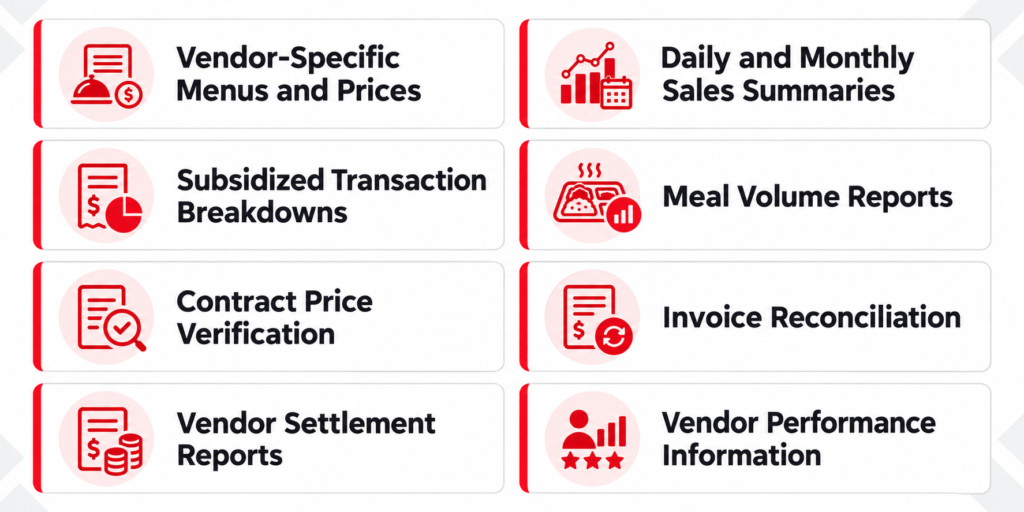
This gives procurement and finance teams a clearer basis for checking claims and processing payments.
Staff Welfare Expense Reporting
Employee meal subsidies represent an important staff welfare expense. A centralized reporting system can help management monitor how the allocated budget is being used.
Department-Level
Meal Expenses
Factory or
Location-Level Costs
Subsidy Budget
Utilization
Meal Consumption
by Period
Employee Contribution
Reports
Shift-Based
Transaction Reports
Vendor Settlement
Summaries
Audit Logs and
Financial Adjustments
These reports support budgeting, cost allocation and more informed discussions with catering vendors.
Key Features to Look For
When selecting a factory Canteen Management System, consider the complete employee meal process rather than only the payment function.
Important capabilities include:
Meal Entitlement
Management
Flexible Subsidy
Configuration
RFID, QR Code or
Biometric Verification
Cashless Payment
Support
Payroll Integration
HRMS Integration
Shift and Overtime
Rules
Multi-Vendor
Management
Real-Time Reporting
Dashboards
Multi-Factory Support
Audit Logs
Privacy and Security
Controls
Reliable Customer
Support
Not every product offers every feature. Request a live demonstration and confirm that the system can support your actual workforce size, policies, infrastructure and reporting requirements.
Implementation Process
1
STEP 1
Review Your Current Meal Policies
Document allowances, employee categories, daily limits, overtime rules and subsidy arrangements.
→
2
STEP 2
Define Operational Requirements
Confirm employees, locations, canteen counters, food vendors and peak meal periods.
→
3
STEP 3
Configure Employee Entitlements
Set rules by employee category, department, shift, location and meal type.
↓
4
STEP 4
Integrate Employee and Payroll Data
Connect HRMS, attendance records, employee databases and payroll processes where supported.
←
5
STEP 5
Conduct Pilot Testing
Test calculations, duplicate-claim controls, devices and exception handling with selected users.
←
6
STEP 6
Launch and Monitor
Train users and monitor accuracy, queues, vendor reconciliation and subsidy expenditure.
Illustrative Factory Subsidy Budget
Consider a factory with:
- 1,000 eligible employees
- 26 eligible working days per month
- RM5 subsidy per meal
- One eligible meal per employee per day
- 100% utilization
The estimated maximum subsidy would be:
- Monthly employer subsidy: RM130,000
- Annual employer subsidy: RM1,560,000
This is a budget estimate, not a guaranteed saving. Actual expenditure depends on employee eligibility, meal usage, company policy and transaction volume.
Built for Malaysian Manufacturing Operations
Manufacturing companies in Malaysia often operate multiple shifts, employ diverse workforces and work with several catering vendors.
A localized solution may need to support:
Malaysian Ringgit
Multiple Languages
Different Factory Shifts
Multiple Sites and
Cost Centres
Local Payroll Processes
Suitable Payment
Arrangements
Personal Data Protection
Requirements
Support During Actual
Factory Operating Hours
Frequently Asked Questions
What is a Canteen Management System?
A Canteen Management System is software that manages employee identification, meal entitlements, food subsidies, cashless payments, transaction reporting and vendor reconciliation within a workplace cafeteria.
How are factory meal subsidies automated?
Employee eligibility, subsidy limits, meal types and shift rules are configured in the system. When an employee purchases a meal, the system verifies the transaction and automatically calculates the employer and employee contributions.
Can the system integrate with payroll?
Compatible systems may integrate through APIs, file exports or other approved data-exchange methods. Payroll-related deductions remain subject to organizational approval and applicable legal requirements.
Can employees use ID cards instead of biometrics?
Yes. Employees may be identified using RFID cards, QR codes, PINs or other supported digital credentials.
Can the system support multiple shifts?
Yes. Meal entitlements can be configured for morning, afternoon, night, rotating and approved overtime shifts.
Can it manage multiple food vendors?
Yes. A multi-vendor system can maintain separate menus, prices, transactions and settlement reports for different food operators.
Can it support thousands of employees?
Yes, provided the selected solution has sufficient capacity, reliable infrastructure, suitable counter throughput and appropriate technical support. Performance should be tested during peak shift breaks.
What should procurement teams ask a software vendor?
Ask about subsidy configuration, employee verification, payroll integration, implementation costs, hardware requirements, system availability, data security, reporting, vendor settlement and support response times.
Modernize Your Factory Canteen
Move away from paper coupons, manual spreadsheets and time-consuming vendor reconciliation.
Our approach focuses on four priorities:
- Accurate employee meal entitlements
- Flexible subsidy management
- Efficient cashless transactions
- Transparent financial reporting
Whether you require a straightforward Employee Meal Allowance System or a comprehensive platform with biometric verification, payroll integration and multi-vendor management, SMART TOUCH TECHNOLOGY SDN BHD can help you identify a suitable solution.
Contact Our Team